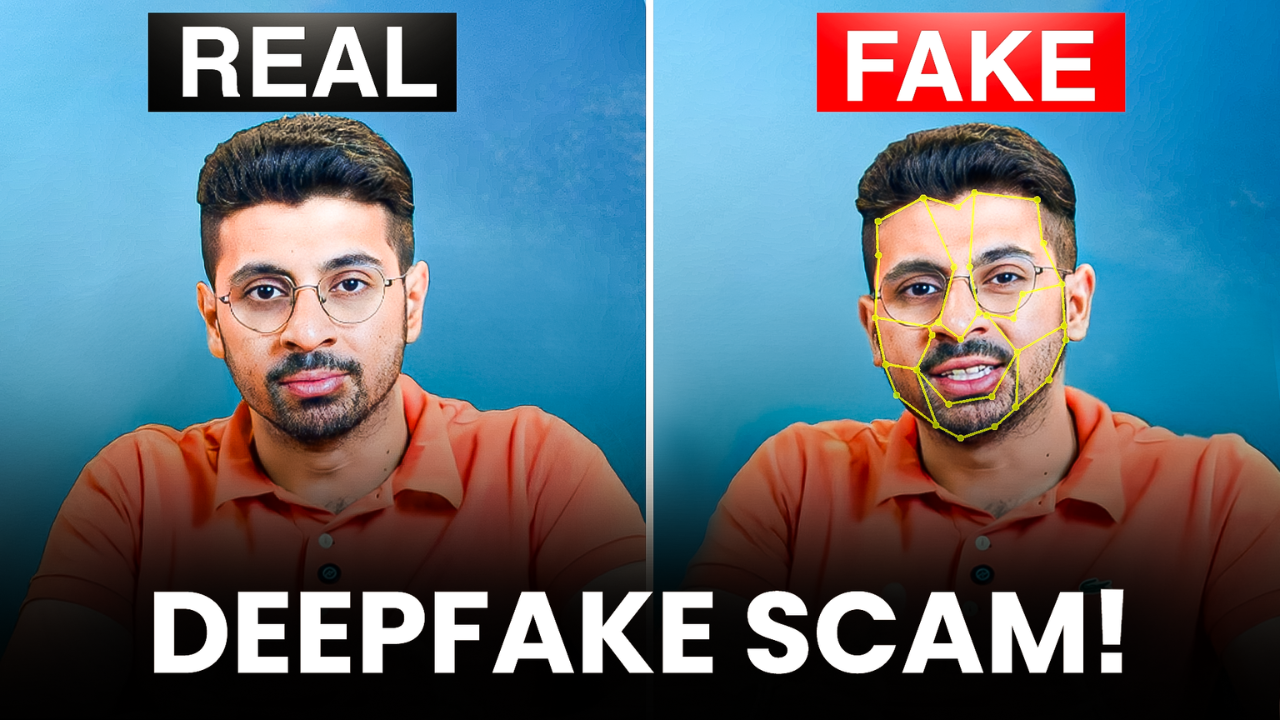

Mukesh Ambani, Kriti Sanon, Nandan Nilekani, Narayana Murthy … can you guess what connects them all?
These A listers were all targeted by impersonators in a bid to gain credibility for their bogus money-managing platforms that have recently become common sight in Facebook. Social media platforms are increasingly becoming a safe space for scammers impersonating celebrities to lure and dupe users thanks to easy availability of AI tools. From deepfakes of business tycoons to fake news reports, here’s how scammers can dupe users online:
Business Titans: A Safe Bet For Scammers
A video allegedly showing a news report elaborating on a ‘financial programme’ developed by the top Indian entrepreneur recently surfaced online. The ‘news report’ claimed, “Mukesh Ambani together with Nandan Nilekani and Narayana Murthy have joined forces and created a financial programme that operates automatically.” It carried video bytes of the trio detailing their alleged ‘financial programme.’ The post also carried a registration link.
Newschecker received a link to one such post on our WhatsApp tipline (+91-9999499044) requesting to be fact checked. Though the post has since been deleted, the video can be seen below.
Did Top Business Moguls Develop Such A Programme?
We looked up keywords “Mukesh Ambani,” “Nandan Nilekani,” “Narayana Murthy” and “automated financial programme,” on Google but did not find any credible reports suggesting that such a venture has been launched by the trio.
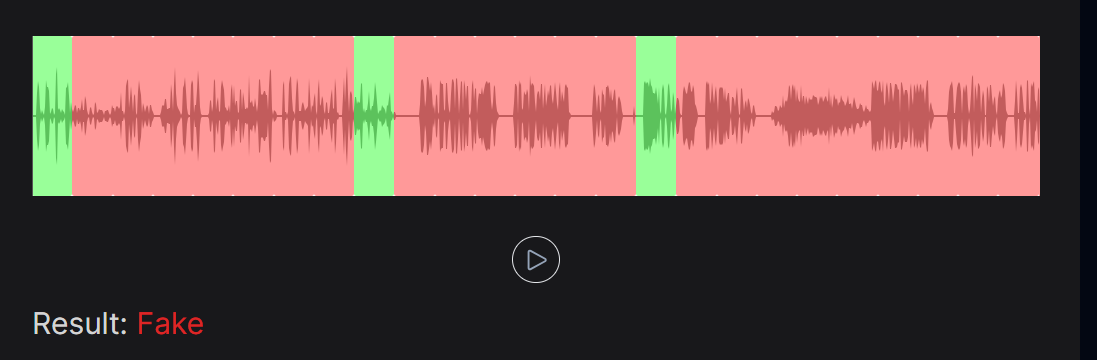
On carefully analysing the video, we observed that while the audio was in sync with the lip movement, their accent was anomalous. We checked the audio on Resemble.ai – a tool for AI audio detection which termed the audio as “fake.”
Following this, we looked up the keyframes of the video on Google to ascertain the whereabouts of the clips of the businessmen used in the footage.
A Google lens search on the frames showing Mukesh Ambani led us to a YouTube video by Jio, dated December 23, 2017. Around 39 minutes into the video, we spotted Ambani addressing the gathering on 40 years of Reliance industries. On comparing the frames of the viral footage with the YouTube video, we found them to be identical. This led us to conclude that Ambani’s clip on the ‘financial programme’ is a deepfake.

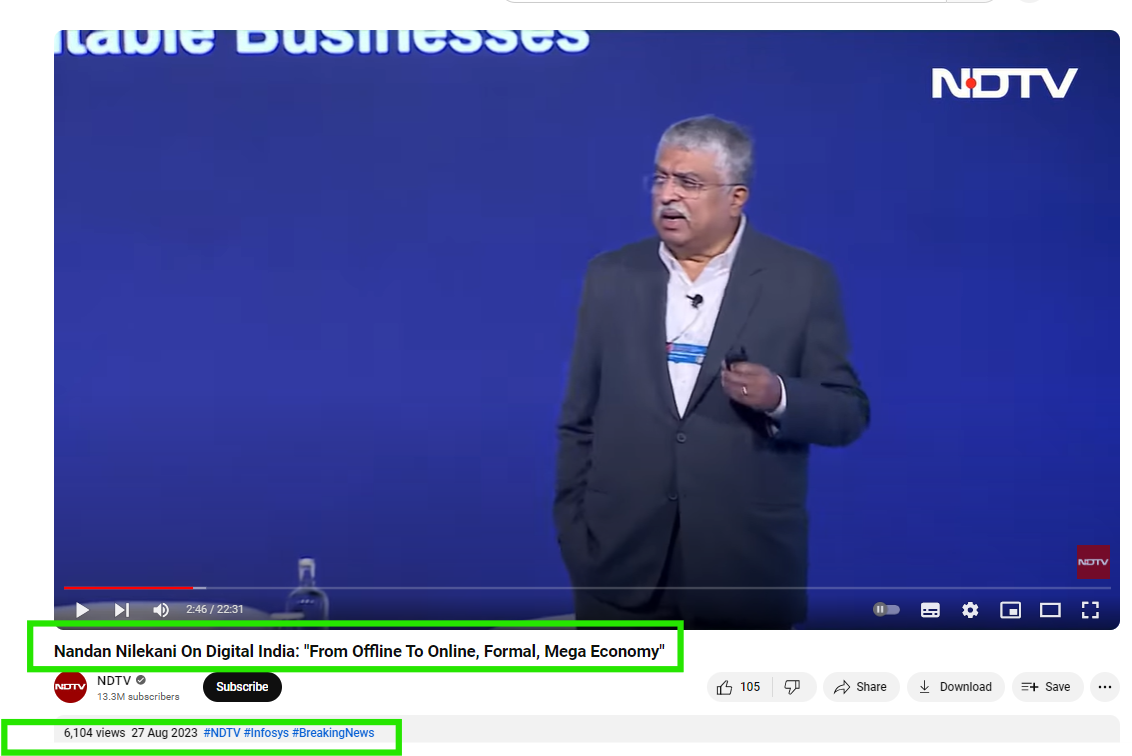
Similarly, Nandan Nilekani’s footage was traced back to his address at the B20 Summit 2023. We also skimmed through a release by B20 Summit on Nilekani’s address, but did not find any mention of an automated financial programme.
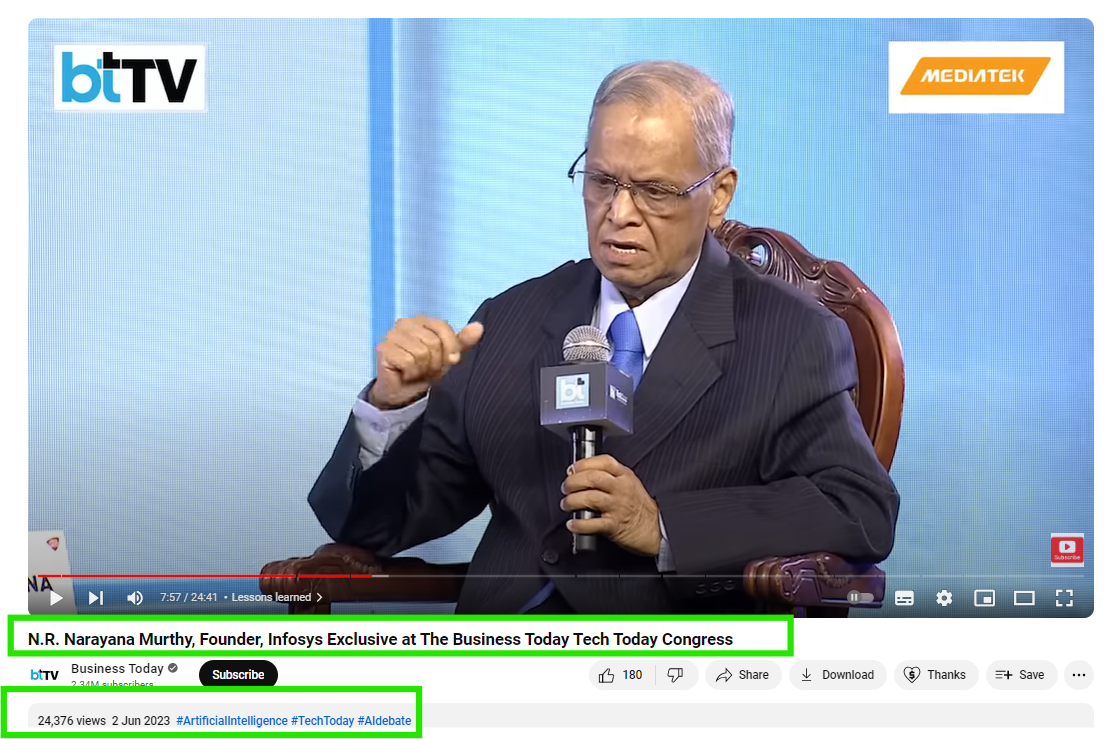
Similarly, Narayana Murthy’s clip was traced back to his interview at the 2023 ‘Business Today Tech Today Congress’ as can be seen here.
The use of deepfakes of business stalwarts to promote financial schemes and money managing platforms have become a common modus operandi. In April, Newschecker debunked a deepfake video of Murthy endorsing an AI trading platform. The same can be seen here. A manipulated video of Ambani promoting a stock market forum had also gone viral on social media platforms. The same was fact checked by us in March.
In December 2023, Ratan Tata had also warned against a deepfake video showing him giving investment advice on Instagram. Reportedly, the caption of the fake post stated, “A recommendation from Ratan Tata for everyone in India. This is your chance to exaggerate your investment right today risk-free with 100% guarantee.”
Popular News Outlets: Easy Deception
Imitating templates or popular news outlets was observed as another way scammers deceive the public and promote their fraudulent schemes. Not long ago, a Facebook page, ‘Roaring Rapids’, shared a ‘report by Indian Express’ on the ‘death’ of singer Neha Kakkar. Featuring the masthead of the news outlet, it stated “Here’s what happened after the scandalous interview with Neha Kakkar.’ On following the link mentioned in the post, we were directed to a website ‘haffizmohdnoor.com.’ The homepage displayed a form to join the “Immediate 1.1 Lidex.”

As per a disclaimer on the homepage, “Immediate 1.1 Lidex is a powerful software utility that connects traders with reputable brokers offering a diverse range of trading options, including cryptocurrencies, Forex, CFDs, and stocks…”

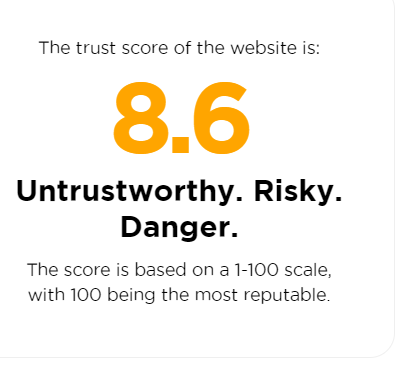
We looked up the website URL on Scam Detector, which termed it “Untrustworthy. Risky. Danger.”
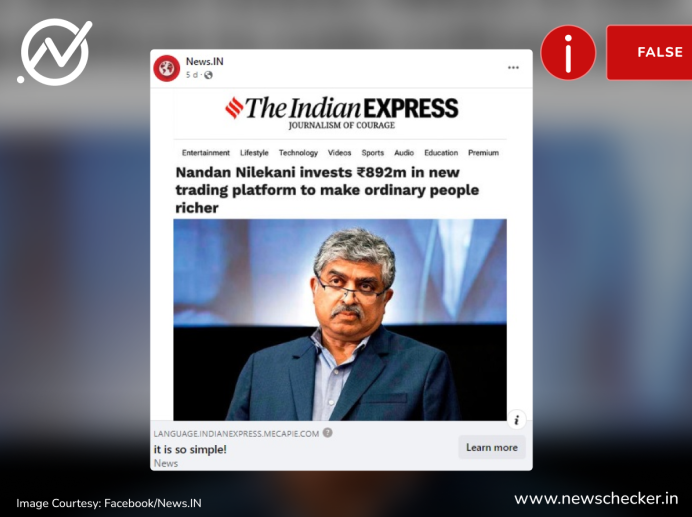
Newschecker has debunked many such instances where scammers imitate Indian Express’ website to dupe gullible people. For instance, in April 2023 Newschecker had debunked a Facebook post sharing the link of a purported Indian Express report that states that Infosys co-founder Nandan Nilekani has “invested $892 million in a new trading platform to make ordinary people richer”.
In September 2023, another fake Indian Express report headlined “JUST IN: Narayana Murti unveils his secret to enrich ordinary Indians” was also debunked by us.
Business moguls Gautam Adani and Azim Premji have also been targeted by similar bogus reports and have been checked by Newschecker.
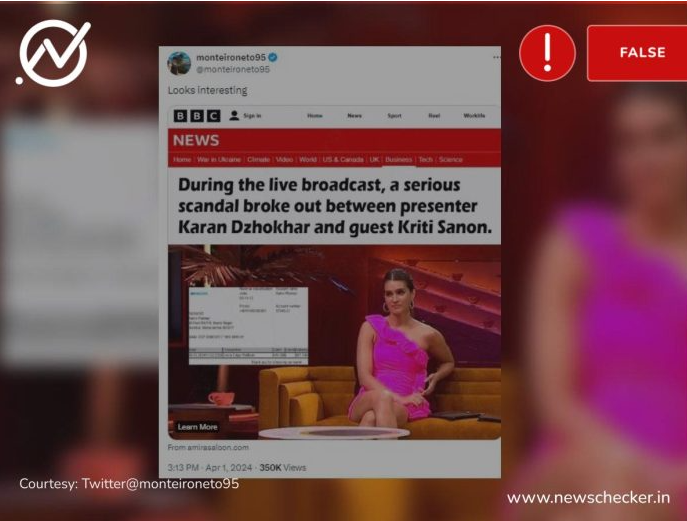
More recently, a fabricated BBC report stating that Bollywood actor Kriti Sanon promoted a “get-rich-quick” trading platform on the talk show “Koffee With Karan” had also gone viral online.
Journalists- The New Favourite
After exhausting a steady stream of businessmen and actors, the scammers seemed to have found another community of people who have their own clout- journalists. Social media posts asking people to join their WhatsApp groups to get exclusive stock market related information are the latest in the slew of misinformation impersonating high profile celebrities.
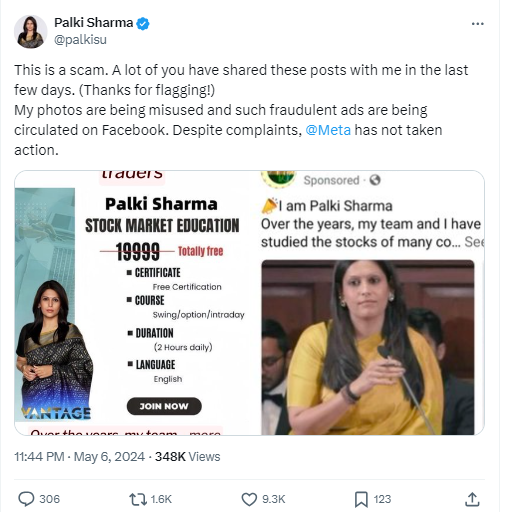
A recent Facebook post claimed that journalist Palki Sharma was offering a ‘stock market education course, and urging users to “join our stock forum community to recommend more high-quality stocks.”
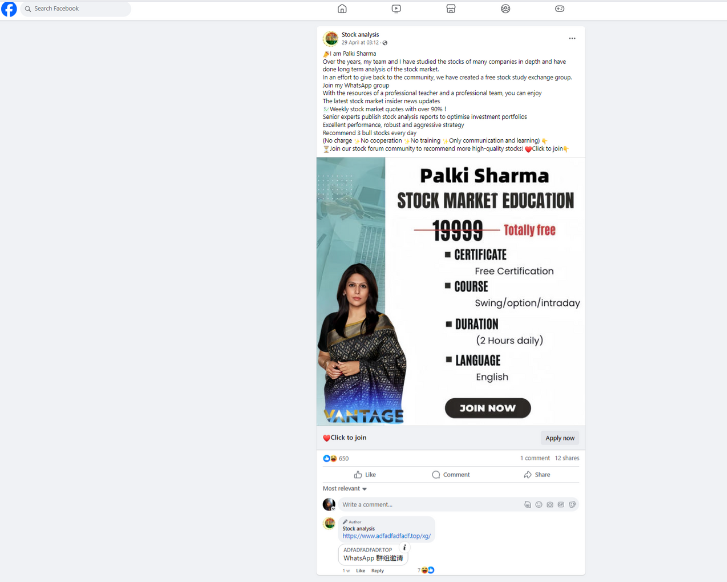
To verify the authenticity of the post, we looked up the official social media handles of Palki Sharma Upadhyay but did not find any mention of a stock market course. We could not spot any credible news reports on the same either.
However, we came across an X post by Sharma, dated May 6, 2024, calling out the fake post. She stated, “This is a scam. A lot of you have shared these posts with me in the last few days. (Thanks for flagging!) My photos are being misused and such fraudulent ads are being circulated on Facebook. “
Also Read: Video Showing Vehicles Driving Over Indian Flag Is From Karachi, Not Kerala
Another Facebook post viral on similar vein carried a screengrab featuring journalist Anuj Singhal’s image, again urging users to join his WhatsApp group to get valuable stock-market related information. Singhal is the Managing Editor of CNBC-Awaaz.
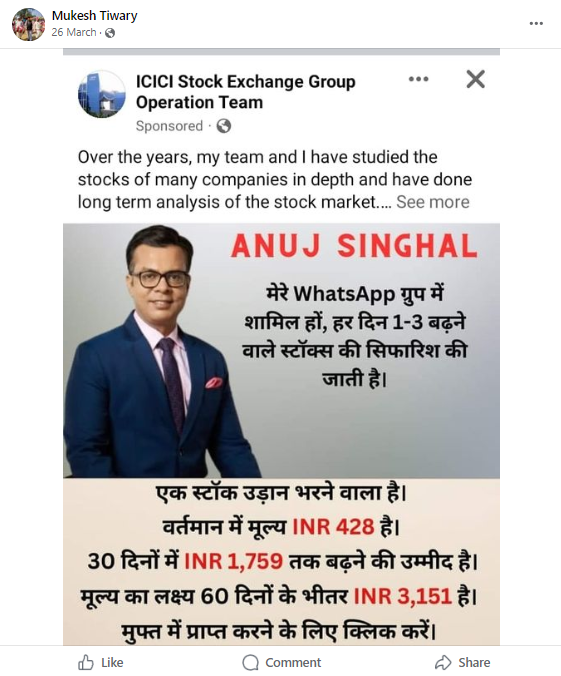
Singhal also clarified on X, saying, “This is a big scam and I have been flooded with people asking if this is real. This is OBVIOUSLY FAKE. Someone is using my image and created a WhatsApp group to promote their shitty stocks. I will be filing a police complaint has and Meta has been notified too. The person running this scam is using a UK number and goes by the name Salina Singh. Please beware that you are joining any such groups at your risk. There is no easy money in markets. (sic)”
https://platform.twitter.com/embed/Tweet.html?creatorScreenName=LVani1234&dnt=true&embedId=twitter-widget-0&features=eyJ0ZndfdGltZWxpbmVfbGlzdCI6eyJidWNrZXQiOltdLCJ2ZXJzaW9uIjpudWxsfSwidGZ3X2ZvbGxvd2VyX2NvdW50X3N1bnNldCI6eyJidWNrZXQiOnRydWUsInZlcnNpb24iOm51bGx9LCJ0ZndfdHdlZXRfZWRpdF9iYWNrZW5kIjp7ImJ1Y2tldCI6Im9uIiwidmVyc2lvbiI6bnVsbH0sInRmd19yZWZzcmNfc2Vzc2lvbiI6eyJidWNrZXQiOiJvbiIsInZlcnNpb24iOm51bGx9LCJ0ZndfZm9zbnJfc29mdF9pbnRlcnZlbnRpb25zX2VuYWJsZWQiOnsiYnVja2V0Ijoib24iLCJ2ZXJzaW9uIjpudWxsfSwidGZ3X21peGVkX21lZGlhXzE1ODk3Ijp7ImJ1Y2tldCI6InRyZWF0bWVudCIsInZlcnNpb24iOm51bGx9LCJ0ZndfZXhwZXJpbWVudHNfY29va2llX2V4cGlyYXRpb24iOnsiYnVja2V0IjoxMjA5NjAwLCJ2ZXJzaW9uIjpudWxsfSwidGZ3X3Nob3dfYmlyZHdhdGNoX3Bpdm90c19lbmFibGVkIjp7ImJ1Y2tldCI6Im9uIiwidmVyc2lvbiI6bnVsbH0sInRmd19kdXBsaWNhdGVfc2NyaWJlc190b19zZXR0aW5ncyI6eyJidWNrZXQiOiJvbiIsInZlcnNpb24iOm51bGx9LCJ0ZndfdXNlX3Byb2ZpbGVfaW1hZ2Vfc2hhcGVfZW5hYmxlZCI6eyJidWNrZXQiOiJvbiIsInZlcnNpb24iOm51bGx9LCJ0ZndfdmlkZW9faGxzX2R5bmFtaWNfbWFuaWZlc3RzXzE1MDgyIjp7ImJ1Y2tldCI6InRydWVfYml0cmF0ZSIsInZlcnNpb24iOm51bGx9LCJ0ZndfbGVnYWN5X3RpbWVsaW5lX3N1bnNldCI6eyJidWNrZXQiOnRydWUsInZlcnNpb24iOm51bGx9LCJ0ZndfdHdlZXRfZWRpdF9mcm9udGVuZCI6eyJidWNrZXQiOiJvbiIsInZlcnNpb24iOm51bGx9fQ%3D%3D&frame=false&hideCard=false&hideThread=false&id=1774459559308038182&lang=en&origin=https%3A%2F%2Fnewschecker.in%2Fscam-watch%2Ffrom-businessmen-to-actors-scammers-impersonate-celebrities-to-dupe-public%2F&sessionId=275928ef4ba02ff82fc4657d3442512ea219a347&theme=light&widgetsVersion=2615f7e52b7e0%3A1702314776716&width=550px
Singhal also put out a video message weaning the public against such fake groups through a video message.
Earlier this week, India Today’s Pooja Shali also took to social media to warn against a fake video featuring her purportedly reporting on an investment opportunity.
Not Just Made In India: Scammers Impersonating Globally
The celebrity impersonating scams are not limited to India, but have a global presence. The Australia’s National Anti-Scam Centre recently issued a warning against “fake news articles and deepfake videos of public figures that endorse and link to online investment trading platform scams, particularly on social media.” Notably, a fake news article stating that Australian actor Hugh Jackman was promoting a trading platform had also gone viral online.

In December 2023, a deepfake video of Singapore’s Prime Minister Lee Hsien Loong promoting a cryptocurrency investment had grabbed eyeballs online.
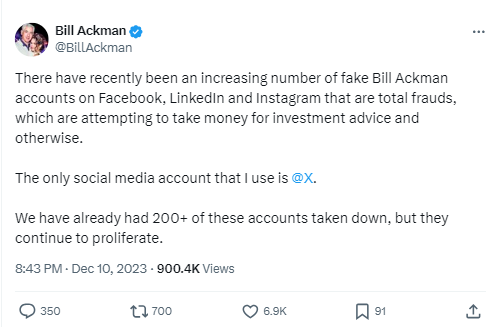
American Billionaire Bill Ackman has also warned against imposter social media accounts “which are attempting to take money for investment advice. “
Also Read: 2019 Video Alleging Voter Fraud By Army Soldiers At BJP’s Behest Goes Viral Amid Lok Sabha Polls
Reportedly, victims of such scams in Japan have sued Facebook. They were “hoodwinked by fraudulent online investment ads that used images of celebrities without their consent, their lawyer said,” reported the Japan Times.
But not such legal remedies are not easily accessible to all and there are several such users who have fallen prey to such fake advertising, and have ended up losing their money.
Sources
Resemble.ai Website
YouTube Video By Jio, Dated December 23, 2017
YouTube Video By Business Today, Dated June 2, 2023
YouTube Video By NDTV, Dated August 27, 2023
Report By Mint, Dated December 7, 2023
Scam Detector Website
X Post By @palkisu, Dated May 6, 2024
X Post By @_anujsinghal, Dated March 31, 2024
Release By ACCC, Dated March 1, 2024
Report By SCMP, Dated December 29, 2023
X Post By @BillAckman, Dated December 10, 2023
Report By Japan Times, Dated April 25, 2024